
Pre-Vacuum vs Gravity Autoclaves: How Air Removal Works
Every steam steriliser has to get the air out before it can sterilise. Gravity machines let steam push it out; pre-vacuum machines pump it out in pulses. How each mechanism works, what the pressure trace looks like, how air removal is proved every day, and which instruments need which.
Two ways to get the air out
WHO groups steam sterilisers by how they remove air: passive air removal by gravity, or dynamic air removal by pre-vacuum or steam-flush pressure pulsing. The difference decides which loads a machine can sterilise, because steam only works where it touches.
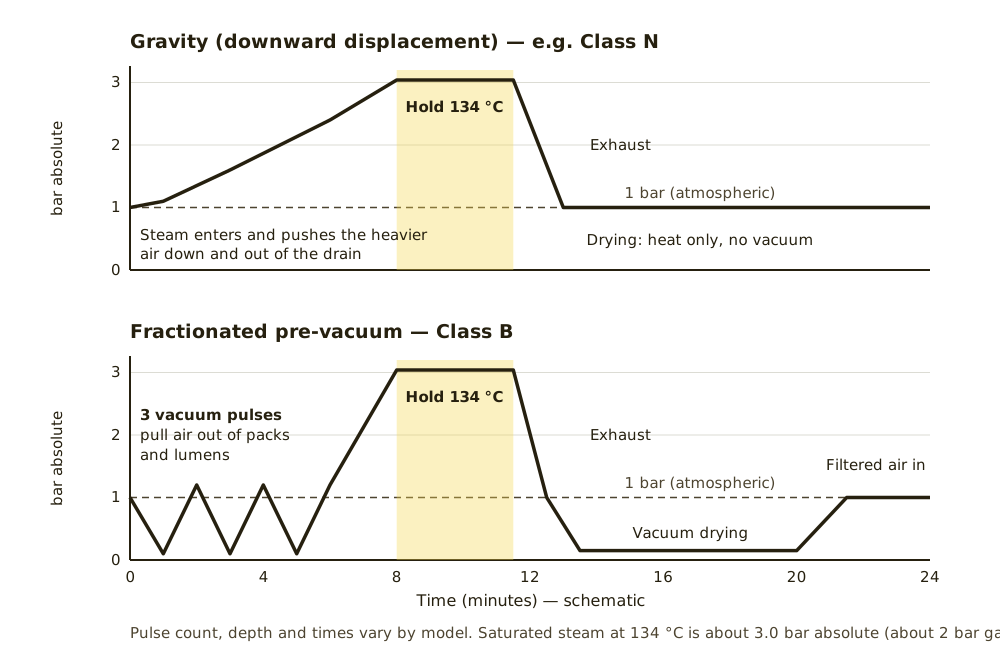
| Gravity (downward displacement) | Pre-vacuum (fractionated vacuum) | |
|---|---|---|
| How air leaves | Steam enters at the top or sides and, being lighter than air, pushes the air out through a drain at the bottom (CDC) | A vacuum pump or water ejector pulls air out of the chamber and the packs, alternating with steam pulses, before the hold |
| Typical conditions | Operates at 121 °C or higher (WHO); CDC lists 30 min at 121 °C for wrapped instruments | Operates at 132–135 °C (WHO); CDC lists 4 min at 132 °C for wrapped items |
| Porous and wrapped loads | Slow and uncertain: air lingers in packs, so steam penetration is prolonged | Nearly instantaneous steam penetration even into porous loads (CDC) |
| Hollow instruments | Not proven for narrow lumens | Designed for them, for the load types the maker declares |
| Drying | Residual heat only; packs dry slowly | Vacuum drying draws moisture out of the packs |
| Tabletop class (EN 13060) | Class N — unwrapped solid instruments | Class B — the load types the maker declares, including wrapped and hollow |
| Daily air-removal test | Not applicable | Bowie-Dick or helix test before the first load |
How a gravity cycle works
CDC notes that gravity sterilisers are used mainly for laboratory media, water, pharmaceutical products, regulated medical waste and non-porous items whose surfaces have direct steam contact.
The sequence
Steam enters and layers above the cooler, heavier air. The air is displaced downwards and out of the drain while the load heats. When the drain line reaches temperature the hold starts; afterwards the steam is exhausted and the load dries with residual heat.
Where it works well
Unwrapped solid stainless instruments that are used straight from the chamber, glassware, and liquids on a liquids programme with slow exhaust.
The liquid cycleWhere it struggles
Inside pouches and wraps, inside cannulas and handpiece channels, and in dense loads. CDC’s example: 10 lb of microbiological waste needs at least 45 minutes at 121 °C because entrapped air slows steam penetration.
Read next Class N autoclaves
How a pre-vacuum cycle works
A Class B tabletop autoclave and a hospital pre-vacuum steriliser work on the same idea: pull the air out, let steam in, and repeat. SHTM 01-01 describes porous-load sterilisers replacing air with steam through a series of vacuum and pressure changes.
Steam-flush pressure pulsing
A third design alternates steam flushes with pressure pulses that stay above atmospheric pressure. Air is removed quickly, as in a pre-vacuum cycle, and air leaks do not affect it because the chamber never goes below atmospheric. CDC gives typical conditions of 132–135 °C for 3–4 minutes for porous loads and instruments.
- Conditioning: the pump pulls the chamber to a deep vacuum, then steam is admitted; this repeats several times.
- Each pulse dilutes what is left. If every vacuum reached a tenth of atmospheric pressure, roughly a tenth of the air would remain after one pulse, a hundredth after two and a thousandth after three — a simplified picture that ignores leaks and air hiding deep in packs.
- Containers with small openings need longer pulses so the pressure inside can equalise, as SHTM 01-01 notes.
- Heat-up and hold: steam brings the chamber to the set temperature — about 3 bar absolute at 134 °C — and holds it for the programmed time.
- Exhaust and vacuum drying: steam is vented, then the pump pulls a vacuum again so condensate boils off the load at a lower temperature.
- Air admission: air returns through a bacterial filter and the door unlocks.
Read next Class B autoclaves
Proving air removal every day
Bowie-Dick test (porous loads)
CDC: run it each day the vacuum steriliser is used, before the first processed load, in an otherwise empty chamber, at 134 °C for 3.5 minutes, with the test pack lying horizontally at the front, bottom, over the drain. A uniform colour change passes; a paler spot shows trapped air.
Helix test (hollow loads)
A process challenge device with an indicator strip at the end of a long, narrow tube. It shows whether steam reached the far end of a lumen — the load Class B tabletop autoclaves are usually bought for.
Vacuum leak test
Many vacuum autoclaves have an automatic leak test that pulls the chamber to vacuum and measures how fast the pressure rises. A leak lets air back in and undoes the pulses.
If a test fails
Do not use the steriliser until it has been inspected by maintenance personnel and passes the test again (CDC). Record the failure and what was done.
Autoclave troubleshootingWhat is optimal: which loads need which
- For a clinic that pouches instruments or reprocesses handpieces, the optimal choice is a Class B machine with a helix test programme and vacuum drying.
- For a laboratory sterilising media, a gravity laboratory autoclave with a liquids cycle and a load probe is usually the better tool.
- If one machine has to do both, check which cycles the maker has validated, not just which cycles it can be set to.
| Load | Gravity / Class N | Pre-vacuum / Class B |
|---|---|---|
| Unwrapped solid stainless instruments, used at once | Suitable | Suitable |
| Instruments in pouches or wraps for storage | Not proven — air stays in packs | Suitable |
| Dental handpieces, cannulas, suction tips | Not proven — air stays in lumens | Suitable when the maker declares hollow loads |
| Textile packs and gauze | Slow; long exposure | Suitable |
| Laboratory media and liquids | The usual choice, on a liquids cycle with slow exhaust | Only on a liquids programme without vacuum |
| Biohazard waste | Possible but slow — long holds | Laboratory machines with pre-vacuum waste cycles exist |
Read next Laboratory autoclavesWhy air stops steam from sterilising
Related guides
Autoclave supply near you
Written quotes for clinics across Malaysia, handled from Batu Caves, Kota Kinabalu and Kuching.
Sources and further reading
Frequently asked questions
What is a pre-vacuum steam sterilizer?
Is a gravity autoclave enough for a clinic?
Why is the Bowie-Dick test run in an empty chamber?
How many vacuum pulses does a Class B autoclave use?
Do pre-vacuum autoclaves dry better?
Get a written quotation
Tell us your clinic or lab type, daily workload and location. We match suitable models and send a written quotation that states who handles delivery, installation and training, and what each costs.
010-905 2891 · Mon–Sat, 9:00 am – 6:00 pm