
How Steam Sterilisation Kills Microorganisms
Steam kills with heat, but not in the way most people picture it. Why moist heat denatures proteins so much faster than dry heat, how condensing steam delivers its energy, what D-value, z-value and F0 actually measure, and which time and temperature pairs the guidelines treat as the minimum.
The kill mechanism: proteins that unfold for good
The CDC guideline for healthcare sterilisation puts it in one line: moist heat destroys microorganisms by the irreversible coagulation and denaturation of enzymes and structural proteins. Water is part of the mechanism, not just the carrier — moisture lowers the temperature at which proteins coagulate. That is why a steam cycle sterilises at 121–134 °C in minutes, while CDC’s dry-heat times run from 60 minutes at 170 °C to 150 minutes at 150 °C.
Enzymes stop working
Enzymes and structural proteins keep their shape through weak chemical bonds. Heat in the presence of water breaks those bonds, the chains unfold and tangle with each other, and they do not refold when the load cools. A cell without working enzymes cannot repair itself or divide.
Spores set the cycle time
Bacterial spores have dehydrated cores and tough coats, so they survive heat far longer than ordinary bacteria. CDC notes that heat-resistant non-spore-forming bacteria, yeasts and fungi die so quickly at 121 °C that their D-values cannot even be measured. Cycles are therefore designed around spores.
Dry heat works another way
Without water, heat kills mainly by slowly oxidising cell components. Dry-heat sterilisers still have a place for items that moist heat would damage, but they need much higher temperatures and much longer times.
Dry heat sterilizersHow condensing steam delivers the heat
Latent heat on contact
When saturated steam touches a cooler instrument it condenses into water and releases its latent heat — more than 2,000 kJ for every kilogram condensed — straight onto that surface. Hot air at the same temperature carries a small fraction of that energy and passes it on slowly.
Condensation pulls in fresh steam
Steam shrinks to a tiny volume of water as it condenses, which draws more steam towards the coldest parts of the load. The coldest surfaces attract the most steam until everything reaches the same temperature.
Steam quality matters
CDC describes ideal sterilising steam as dry saturated steam with a dryness fraction of at least 97%. Wetter steam soaks packs; superheated steam behaves like hot air and condenses poorly; air or other non-condensable gases mixed in lower the temperature at a given pressure.
Feed water and steam qualityPressure is only the means
CDC lists four parameters — steam, pressure, temperature and time — and notes that pressure serves as a means of reaching the high temperatures needed. About 1 bar above atmospheric gives saturated steam at roughly 121 °C; about 2 bar gives roughly 134 °C.
Temperature and pressure explainedWhy trapped air defeats the cycle
WHO’s reprocessing manual is blunt: sterilisation cannot occur in the presence of air. A pocket of air sits on a surface like a blanket. Steam cannot condense through it, so the metal underneath heats only by slow conduction, much as it would in a hot-air oven. Air mixed into the steam also lets the chamber show the right pressure while the temperature is lower than it should be.
- Pouches, wraps, textiles and hollow instruments trap air that gravity alone struggles to push out.
- CDC gives the example of 10 lb (about 4.5 kg) of microbiological waste, which needs at least 45 minutes at 121 °C in a gravity steriliser because entrapped air slows steam penetration so much.
- Vacuum autoclaves remove air with repeated vacuum pulses before the hold, and a daily Bowie-Dick or helix test proves they still do.
Read next Pre-vacuum vs gravity air removalBowie-Dick and helix tests
D-value: how fast the kill happens
Microorganisms do not all die at once. At a fixed temperature the same fraction dies in each interval, so the survivor count falls in a straight line on a log scale. The D-value is the time it takes to kill 90% of the population — one log. CDC gives D-values at 121 °C of 1 to 2 minutes for the Geobacillus stearothermophilus spores used to test steam sterilisers.
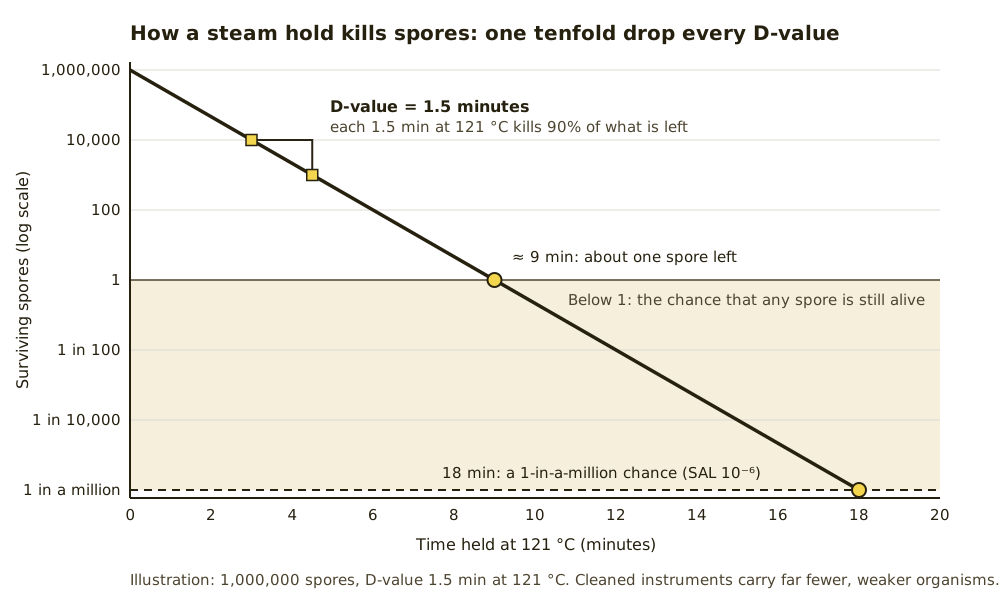
| Time held at 121 °C | Log reductions | Expected survivors |
|---|---|---|
| 1.5 min | 1 | 100,000 |
| 4.5 min | 3 | 1,000 |
| 9 min | 6 | About 1 |
| 13.5 min | 9 | 1-in-1,000 chance of one survivor |
| 18 min | 12 | 1-in-1,000,000 chance of one survivor |
z-value and F0: trading temperature for time
The z-value is the temperature change that makes the D-value ten times shorter or longer. For steam processes a z-value of 10 °C is the usual reference. In Mesa Labs’ worked example, a spore with a D-value of 2.0 minutes at 121 °C drops to 0.2 minutes at 131 °C and rises to 20 minutes at 111 °C. F0 adds up the lethality of a whole cycle — heat-up, hold and cool-down — as equivalent minutes at 121 °C, calculated with z = 10 °C.
- Each 10 °C rise kills roughly ten times faster, which is why 134 °C needs a few minutes where 121 °C needs a quarter of an hour.
- Real biological indicators rarely have a z-value of exactly 10 °C, so a thermocouple’s F0 figure and the spores’ actual kill can differ, especially during slow heat-up and cool-down (Mesa Labs).
- Standards time the hold from the moment the slowest-heating part of the load reaches sterilisation temperature (SHTM 01-01). Heat-up and cool-down add lethality, but they are a margin, not part of the count.
What is optimal: minimum time and temperature pairs
There is no single best temperature — there are validated pairs. The figures below are minimum holding times, not total cycle times. Points above the dashed line deliver more lethality than 15 minutes at 121 °C.
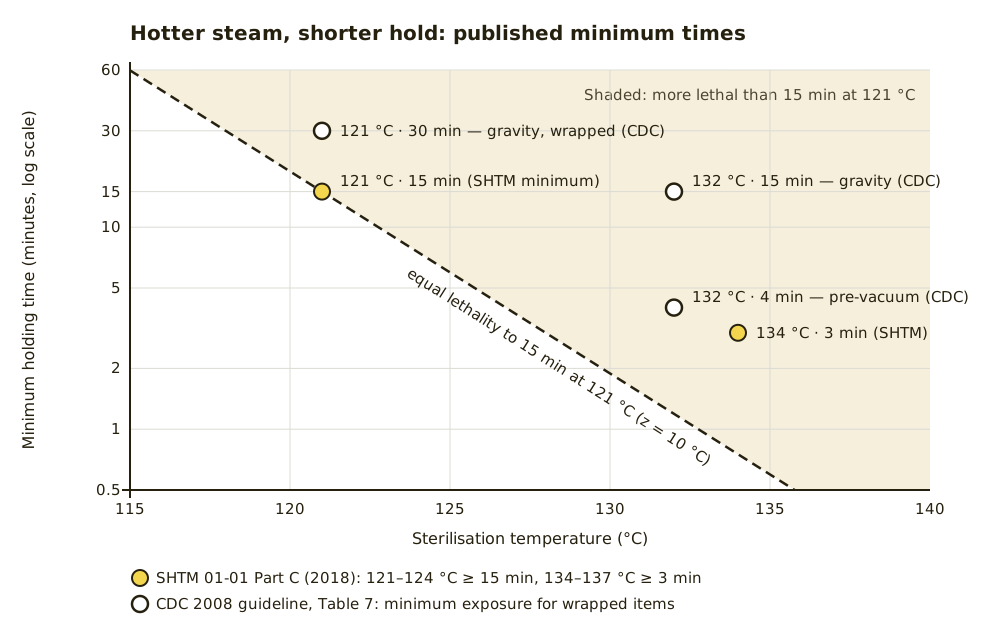
- Use the highest temperature every item in the load is rated for — usually 134 °C for stainless instruments — because the hold is short and the machine turns round faster.
- Drop to 121 °C only when an item’s instructions for use require it, and accept the longer hold.
- Never shorten the drying phase to save time; CDC’s Table 7 lists 20–30 minutes of drying for wrapped instruments in a pre-vacuum steriliser.
| Temperature | Minimum hold | Source | Typical use |
|---|---|---|---|
| 121–124 °C | 15 min | SHTM 01-01 Part C, Table 1 | Items rated only to 121 °C; some rubber and plastics; liquids in a laboratory autoclave |
| 121 °C, gravity, wrapped | 30 min | CDC 2008, Table 7 | Wrapped instruments, textile packs and utensils in a gravity steriliser |
| 132 °C, gravity | 15 min instruments; 25 min textile packs | CDC 2008, Table 7 | Gravity sterilisers run at the higher temperature |
| 132 °C, pre-vacuum | 4 min | CDC 2008, Table 7 | Wrapped instruments, textiles and utensils with dynamic air removal |
| 134–137 °C | 3 min | SHTM 01-01 Part C, Table 1 | Most stainless instruments on a vacuum (Class B) tabletop cycle |
Read next Why packs come out wet
SAL 10⁻⁶: what “sterile” means in numbers
CDC defines the sterility assurance level (SAL) as the probability of a single viable microorganism remaining on an item after sterilisation. Critical items such as scalpels and implants are processed to an SAL of 10⁻⁶ — no more than a one-in-a-million chance that an item carries a survivor. It is a probability worked out from the bioburden, the D-value and the cycle, not something a test can see on a single instrument.
- The cleaner the item, the lower the starting count and the more margin the same cycle has. Cleaning is part of the sterility calculation.
- A biological indicator carries a far bigger and tougher challenge than a cleaned instrument, so a cycle that kills it has a wide margin on real loads.
- Physical records, chemical indicators and spore tests together show the cycle delivered what it was validated to deliver.
Read next Cleaning before sterilisationSpore tests and biological indicators
Related guides
Autoclave supply near you
Written quotes for clinics across Malaysia, handled from Batu Caves, Kota Kinabalu and Kuching.
Sources and further reading
- CDC — Guideline for Disinfection and Sterilization in Healthcare Facilities (2008, updated June 2024)
- NHS National Services Scotland — SHTM 01-01 Part C: Sterilization by steam (2018)
- Mesa Labs — Spore News: the z-value and calculating sterilisation lethality
- WHO — Decontamination and Reprocessing of Medical Devices for Health-care Facilities (2016)
Frequently asked questions
How does steam sterilisation kill bacteria?
What is the D-value in sterilisation?
What does F0 mean for an autoclave?
Is 121 °C or 134 °C better?
Why must air be removed before sterilising?
Get a written quotation
Tell us your clinic or lab type, daily workload and location. We match suitable models and send a written quotation that states who handles delivery, installation and training, and what each costs.
010-905 2891 · Mon–Sat, 9:00 am – 6:00 pm