
Autoclave Repair: Getting a Broken Steriliser Fixed and Safely Back in Use
When the steriliser stops in the middle of a clinic week, the order of what you do matters. Protect patients first, give the right engineer the right information, and release loads only after the machine has passed its tests again.
The repair route, step by step
Repair is the second job. The first is deciding which instruments are safe to use, because a steriliser can fail quietly before it fails loudly.
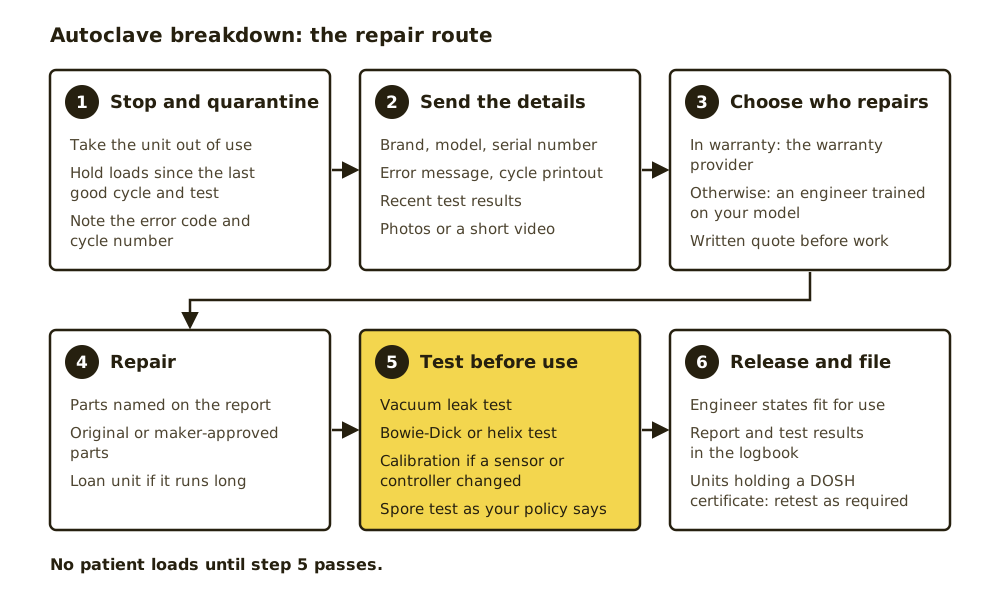
- Take the unit out of use and label it, so no one starts another cycle.
- Hold every load processed since the last cycle and test that you know were good, and follow your recall policy for anything already used.
- Write down the error code or message exactly as shown, the cycle number and what was in the chamber, before you switch anything off.
- Keep the printout or data record of the failed cycle.
- Run only the user checks the manual allows. Never open panels, bypass a sensor or force the door: the chamber holds steam under pressure.
Read next User checks for common faultsWet packs after autoclaving
What to send for a repair quote
Most first answers come from a few phone photos. The more of this an engineer has before the visit, the more likely the right part travels with them.
| Send | Why the engineer needs it |
|---|---|
| Brand, model and serial number from the rating plate, and roughly when it was installed | Parts and software differ between versions of the same model name |
| The error code or message, exactly as displayed | Points to the circuit or sensor that tripped the cycle |
| The printout or data log of the failed cycle | Shows where pressure or temperature went outside its limits |
| Your latest vacuum leak, Bowie-Dick or helix and spore test results | Separates an air leak from a steam penetration or sterilisation problem |
| Photos or a short video of the display, the door seal, any leak or unusual noise | Allows remote triage, and sometimes a fix your staff can do |
| The water you use and the date of the last service | Scale from the wrong water is a common cause of valve and generator faults, and a common warranty exclusion |
| Your address and clinic hours | Decides who can attend, how far they travel and how parts reach you |
Who repairs it: warranty, authorised service or an independent engineer
Still under warranty
Call the company named on your warranty first. Makers commonly restrict repairs to authorised people: MELAG’s Vacuklav 24 BL+ manual, for example, says to have the device repaired only by authorised persons and to use only original MELAG spare parts. Work by anyone else can void the warranty.
Authorised service after the warranty
Engineers trained on the brand usually have the service software, test adaptors and original parts for your version, and know its common faults. Ask for a written quote and a response time.
Independent engineer
Can be quicker, especially outside the big cities. Ask whether they are trained on your brand and model, whether they can get original parts and run the service software, whether their test instruments are calibrated, and what warranty they give on the repair.
Competence in Malaysia
MDA runs a voluntary registration programme for technical personnel — service engineers, biomedical engineers and technicians — who install, test, commission and maintain medical devices. Because it is voluntary, also ask about training on your exact model. MDA’s Good Distribution Practice (GDPMD) framework treats service, maintenance and calibration as controlled supply-chain work.
Sterilisers holding a DOSH certificate of fitness
Malaysia’s Occupational Safety and Health (Plant Requiring Certificate of Fitness) Regulations 2024 apply to plant that needs a certificate of fitness. Under regulation 9, the owner must give written notice to a DOSH officer or licensed person before repairs, have them carried out by a competent person in line with the manufacturer’s requirements, and have the plant tested and examined afterwards under a competent person’s supervision. Ask your supplier whether your unit is covered.
Read next Service questions to ask a supplierService contracts and response times
Common repairs and how they show up
The same handful of parts cause most call-outs on tabletop sterilisers. The symptom is a clue, not a diagnosis — the engineer confirms it.
| Part | Typical symptom | Worth knowing |
|---|---|---|
| Door seal (gasket) | Steam or water at the door; failed vacuum leak test | Often a user-changeable part on tabletop units if the manual describes it; it must sit the right way round in its groove |
| Bacteriological (air) filter | Slow venting at the end of the cycle; a filter message after a power cut | Some models require the filter to be replaced or sterilised after a power failure under pressure |
| Vacuum pump | Failed vacuum leak, Bowie-Dick or helix tests; long air-removal phases | An engineer’s job, followed by retesting |
| Solenoid and non-return valves | Pressure not holding, leaks, aborted cycles | Scale and debris from poor feed water are common causes |
| Steam generator or heating element | Slow heat-up, no steam, tripping the supply | Limescale from tap water shortens their life |
| Temperature and pressure sensors | Readings out of tolerance; cycle aborted with a sensor fault | Calibration must be checked after a sensor is replaced |
| Control board, display or software | Blank display, random or repeated errors | Ask whether a firmware update addresses the fault |
| Door lock and switches | Door will not lock or open; lock error | A safety part: stop using the unit until it is checked |
| Printer or data logger | No cycle record | Without a record, the load cannot be released under most policies |
Read next Spare parts, intervals and orderingWater quality and scale
Tests before the steriliser goes back into use
NHS Scotland’s SHTM 01-01 Part C says users should have a written procedure for returning a steriliser to service after maintenance, with safety checks and some or all of the yearly revalidation tests; a competent person certifies the work is complete and the steriliser safe, and it is not used until the work is done. The UK MHRA’s benchtop advice likewise asks for written records of all testing and maintenance.
- A vacuum leak test on vacuum (Class B) units.
- A Bowie-Dick or helix air-removal test.
- A test cycle with its printout checked against the limits.
- Verification of calibration if a sensor, controller or pressure part was replaced.
- A spore test (biological indicator) on a normal load, as your policy requires after repairs.
- A written statement from the engineer that the unit is fit for use, filed with the test results in the logbook.
Read next Bowie-Dick, helix and validation testsRunning a spore testWhen a repair means requalification
Repair or replace?
Compare the full cost of each route: the repair, travel, retesting and downtime, against a new unit with its installation and first tests.
| Leans towards repair | Leans towards replacing |
|---|---|
| The maker still supports the model and parts are available in Malaysia | The maker has ended support, or parts must come from overseas with long lead times |
| One part has failed on an otherwise reliable unit | Faults keep coming back in different systems |
| The chamber, door and frame are in good condition | The chamber is corroded or damaged, or the door no longer seals properly |
| The repair is a modest share of the price of a new unit | The repair plus retesting approaches the cost of a new unit |
| The steriliser still suits your loads | Your loads have changed — for example you now need a Class B cycle for wrapped or hollow items |
Read next How buying a new autoclave worksSecond-hand autoclave checksWhat drives the price
Related guides
Autoclave supply near you
Written quotes for clinics across Malaysia, handled from Batu Caves, Kota Kinabalu and Kuching.
Sources and further reading
- NHS National Services Scotland — SHTM 01-01 Part C: Sterilization by steam (2018)
- MHRA — Top Ten Tips: Benchtop Steam Sterilizers (December 2013)
- Occupational Safety and Health (Plant Requiring Certificate of Fitness) Regulations 2024, P.U.(A) 99/2024 — in operation 1 June 2024
- MELAG — User Manual, Vacuklav 24 BL+ steam sterilizer (servicing intervals, spare parts and technical data)
- Medical Device Authority — Medical device technical competency regulatory programme: voluntary registration of technical personnel
- Medical Device Authority — FAQs: Registration, Licensing and Enforcement (including GDPMD)
Frequently asked questions
How much does an autoclave repair cost?
Can I repair an autoclave myself?
How long does an autoclave repair take?
Do I need to retest the autoclave after a repair?
Does DOSH need to be told about an autoclave repair?
How do I find autoclave repair near me?
Get a written quotation
Tell us your clinic or lab type, daily workload and location. We match suitable models and send a written quotation that states who handles delivery, installation and training, and what each costs.
010-905 2891 · Mon–Sat, 9:00 am – 6:00 pm